
How Many Lumens Does Each Room Need? A Simple Guide
A good starting point is roughly 10 to 20 lumens per square foot (about 110 to 215 lumens per square metre) for living rooms and bedrooms, and 30 to 40 lumens per square foot (about 320 to 430 per square metre) for kitchens and work areas. Multiply your room's floor area by the range for that room type, then split the total across several light sources instead of relying on one fixture. These are general rules of thumb, so adjust up or down for dark walls, big windows and how you use the room.
What a lumen is, and why it beats watts
A lumen measures how much visible light a bulb or fixture puts out. Watts only tell you how much electricity it draws. Since LED lighting is far more efficient than older bulbs, a wattage number no longer tells you how bright a lamp will be. When you shop, look for the lumen figure on the bulb or fixture packaging and compare that instead.
Lumens also differ from colour temperature, which describes how warm or cool the light looks. A bright light can still feel cosy if it is warm white, and a dim one can feel harsh if it is cool white. Plan the amount first, then pick the tone.
How to calculate lumens for your room
- Measure the room's length and width and multiply them to get the floor area.
- Pick the range for the room type from the table below.
- Multiply the area by the range to get a target total in lumens.
- Divide that total between your ceiling light, lamps and any accent lighting.
For example, a 4 m by 5 m living room is 20 square metres. At roughly 110 to 215 lumens per square metre, that is about 2,200 to 4,300 lumens in total, spread across a ceiling fixture and two or three lamps.
Lumens per room: a quick reference
| Room | Lumens per sq ft | Lumens per sq m (approx.) | Notes |
|---|---|---|---|
| Living room | 10 to 20 | 110 to 215 | Mix ceiling light with lamps so you can dim the room down |
| Bedroom | 10 to 20 | 110 to 215 | Add bedside lighting for reading |
| Dining room | 10 to 20 | 110 to 215 | Dimmable is useful for dinner versus homework |
| Kitchen | 30 to 40 | 320 to 430 | Add task light over worktops |
| Home office | 30 to 50 | 320 to 540 | Aim light at the desk, not into your eyes |
| Hallway or stairs | 5 to 10 | 55 to 110 | Even light matters more than brightness |
| Bathroom | 40 to 50 | 430 to 540 | Lighting beside the mirror helps with grooming |
Sources differ slightly on these numbers, so treat them as a guide rather than a rule.
Spread the lumens across layers
One bright overhead light tends to flatten a room and create glare. It usually works better to combine three layers: general (ambient) light from the ceiling, focused light for tasks like reading, and softer accent light for atmosphere. A common approach is to let the ceiling light provide a base level and make up the rest with lamps, which also lets you change the mood by switching individual lights on and off.
Our ceiling lights are a natural base layer, while a floor lamp or a table lamp fills in the corners and gives you reading light.
Factors that change how many lumens you need
Wall and furniture colour
Dark walls and dark furniture absorb light, so a room with them may need toward the top of the range. Pale walls reflect more light and often feel bright with less.
Natural light
A room with large windows can feel bright by day, but you still need to plan for the evening, when the lamps do all the work.
Ceiling height
Taller ceilings spread light over a bigger volume. If your ceilings are high, consider adding more fixtures at different heights.
Dimming
If a fixture can be dimmed, you can size it for the brightest use and turn it down for evenings. This is often the easiest way to avoid guessing wrong. Check the product details to confirm whether a specific light is dimmable.
Age and eyesight
Reading and detailed work generally feel easier with more light, so you may want a brighter task lamp for those spots.
Our picks
These are products from our current range that suit the layered approach above. We have not listed lumen outputs because they are not given in our product data, so check the variant details on each page.
- Three-Colour LED Ceiling Light: a low-profile ceiling light with integrated LED and three colour temperature settings from warm to cool white. It mounts directly to the ceiling, which suits bedrooms, hallways, kids' rooms and standard ceiling heights.
- Rotatable LED Ceiling Light: a dimmable integrated LED ceiling light with three colour temperature settings, a good general light for bedrooms, balconies and dining rooms.
- Sun Dial Ceiling Light: a statement fixture that comes in sizes from 80 cm to 128 cm in diameter, suited to larger rooms where one fixture does a lot of the work.
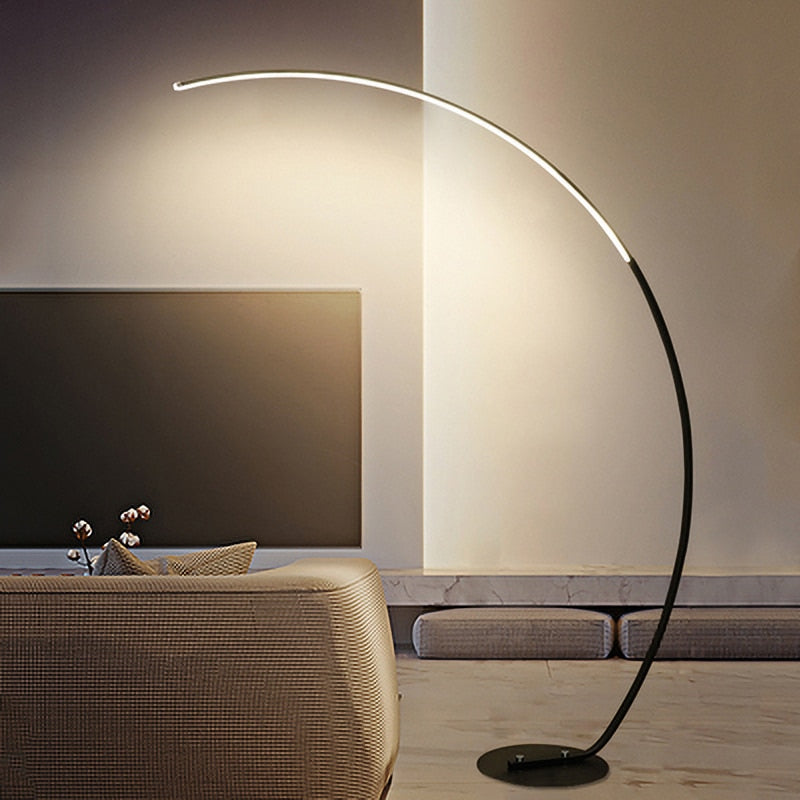
- Nordic Arc Floor Lamp: an arc-shaped floor lamp, 170 cm high, with a colour temperature range of 3000K (warm white) to 6000K (cool white). Useful for adding a reading or accent layer beside a sofa.
- Dawn Floor Lamp: a slim, 150 cm tall floor lamp with a fabric drum shade that gives a warm, soft glow for accent light in living rooms and bedrooms.
Not sure which suits your space? Our FAQ page covers ordering, delivery and product questions.
Frequently asked questions
How many lumens do I need in a living room?
A common guide is 10 to 20 lumens per square foot, which is about 2,000 to 4,000 lumens for a 200 square foot room. Split that across a ceiling light and several lamps so you can adjust the mood.
Is more lumens always better?
No. Too much brightness in a living room or bedroom can feel harsh and glaring. Plan for the brightest you will need and add dimming or multiple light sources so you can bring it down.
Do I count the lumens of every lamp in the room?
Yes, add up the lumens of every light source that will be on at once and compare the total to your target. Dividing the total between several lamps gives a more even result than one very bright fixture.
Who should install a new ceiling fixture?
If installing or replacing a hardwired fixture involves any electrical work, hire a licensed electrician.
Modern Space Living offers free standard shipping worldwide, with delivery in 2–4 weeks (chairs and wall panels 7–10 weeks) and a 2-year warranty.


%20for%20living%20rooms%20and%20bedrooms,%20and%2030%20to%2040%20lumens%20per%20square%20foot%20(about%20320%20to%20430%20per%20...)